
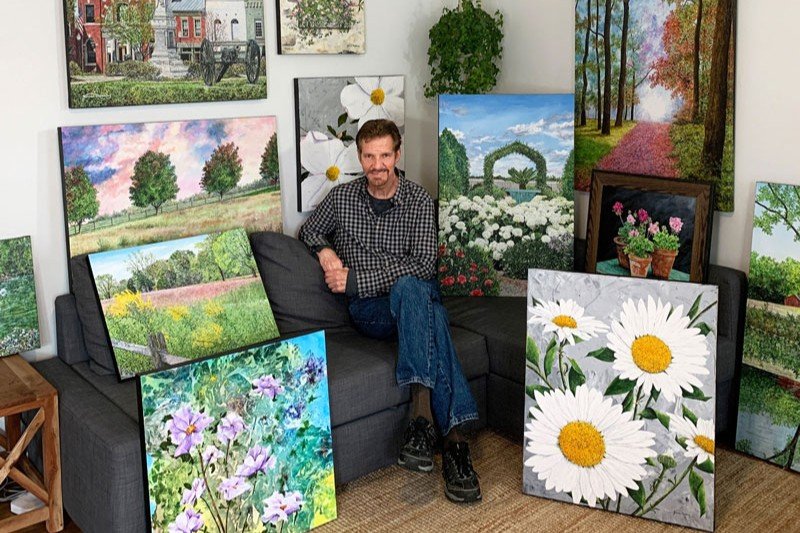
Most painter biographies open with a school. A degree, a mentor, a program with a reputation attached. James Redding’s story starts somewhere very different. He never had formal art training, and there was no traditional path leading him toward a career as a painter. Instead, he spent his early career in visual merchandising for a large retail company, creating store displays and windows. It was creative work, but it wasn’t painting. Then a family move to Bucks County, Pennsylvania changed the direction of his life. He left retail behind, picked up his brushes, and began figuring out how to make a living from art on his own terms.
What followed wasn’t an overnight success or a carefully planned career. Redding started by painting the places around him, from local landscapes to historic buildings, and built his reputation gradually through galleries, art shows, and festivals. Everything he knows came through years of practice, experimentation, and working with different techniques and mediums. His story is a little different from the usual artist biography, but that’s what makes it worth looking at: how does someone with no formal training go from retail displays to a lifelong career as a painter?
Key Takeaways
No Formal Training at All: He is completely self-taught, and he learned by experimenting with techniques and mediums over many years.
Retail Display Came First: Before painting he worked in visual merchandising for a large retail company, a creative job that was not art.
A Family Move Opened the Door: A promotion took the family to Bucks County, where he left retail to paint.
Local Subjects Built the Career: He started with nearby landscapes and historic buildings, then galleries, art shows, and festivals followed.
Skill Is Taught, Creativity Is Not: In his words you can develop technique, though creativity comes from somewhere inside you.
If you would like to talk about a piece or a commission, please get in touch.
The Career Before Painting
It is easy to look at those years and think of them as the period before the real work began. But that misses something important. His time in visual merchandising was not painting, but it was still training his eye.
Visual merchandising is composition under pressure. You have a limited space, a collection of objects, a season to work around, and a deadline. More importantly, you have only a few seconds to make someone walking past stop and look. You learn how to guide the eye through a display, what deserves attention, and what needs to be left out. Put too many ideas in one window and none of them has room to stand out.
Those are the same problems a painter faces, just in a different setting. A landscape needs a clear point of focus. Every color, shape, and detail has to serve the scene rather than compete with it. Look closely at Redding’s work and that same sense of composition comes through. The subject takes the lead, while everything around it works to draw your eye back to where it belongs.
The Decision Arrived With a Move
The turn came when his wife accepted a promotion and the family relocated to Bucks County, Pennsylvania.
People skip past that detail, although it is the part that actually matters. A move creates a gap, because the old job is gone and nothing has settled into a routine yet. For most of us that gap closes fast, filled by whatever appears first.
He used it differently. Retail went behind him and the brushes came out. He set about finding whether a living could be made from it. There is no version of that decision without risk, since he had no degree to fall back on and no gallery waiting.
A Self-Taught Artist Builds It One Local Scene at a Time
What came next was not a sudden breakthrough. It was accumulation.
Redding started by painting what he knew. Local landscapes, historic buildings, and familiar corners of Bucks County became his subjects. These were places people passed every day, but on his canvas they became something worth stopping to notice. The work began to attract attention. Local galleries started carrying his paintings, followed by art shows and festivals. One opportunity led to another, and over time, what began as an uncertain experiment quietly grew into a career.
That is often what a self-taught path really looks like. There is no single moment when everything falls into place. Instead, there is a long series of small proofs: another painting, another person who connects with it, another gallery willing to show it. A career takes shape gradually, built one painting and one local scene at a time.
What Does Self-Taught Actually Mean Here?
For a self-taught artist the phrase can sound like a gap in a resume, yet in practice it describes a method.
He learned by doing. Trying techniques, working across different mediums, getting things wrong, and putting in the hours. Because nobody handed him a shortcut, nothing in the style arrived secondhand. The fine detail, the handling of light, the decision to work in acrylics, all of it was arrived at rather than taught.
His own summary is blunt enough. You can learn techniques and develop your skills. Creativity comes from within, and painting has always meant following that instinct. If you are weighing an original against a print, the post on original paintings and prints walks through the difference.
Frequently Asked Questions
Did James Redding go to art school?
No. He is a completely self-taught artist with no formal training. The learning came through years of experimenting with techniques and mediums.
What did he do before painting full time?
He worked in visual merchandising for a large retail company. It was creative work, although not painting, and he left it after a family move to Bucks County, Pennsylvania.
How did he build a career without training?
He began with local subjects, then galleries in the area started carrying the work, and art shows and festivals followed from there.
What medium does he work in?
Acrylics. He works exclusively in acrylics now and is known for fine detail and vibrant color. Earlier work, including the pieces reproduced as lithographs, was painted in watercolor with a more subdued palette.
Can I commission a painting from him?
Yes. Commissions have been part of the work for years, including scenes of meaningful places and portraits, and the studio handles each one personally.
Still Walking Into the Studio
The part he returns to is not the galleries or the shows. It is the ordinary fact of the mornings.
After all these years he still counts it as good fortune. He gets to walk into the studio, pick up his brushes, and do what he loves. For someone who once arranged other people’s products in other people’s windows, that is not a small thing to say.
You can browse the work on the prints page, or reach out about a commission of your own.