
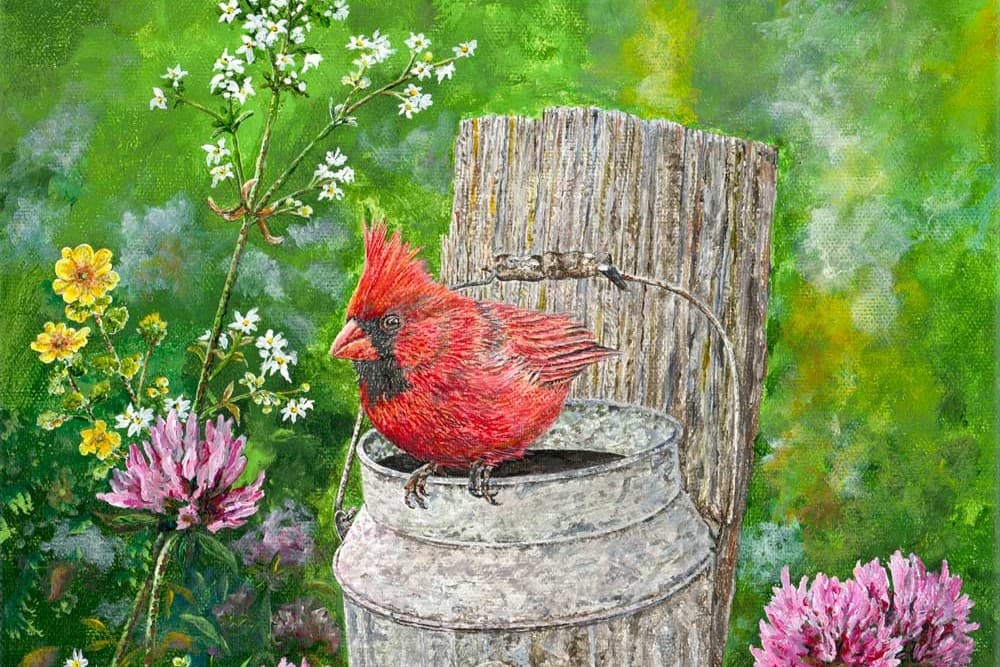
A woman wrote to the studio one January asking for something red. Her kitchen window looked onto a feeder, and the cardinal that visited it every morning was the only color in the yard until March. She wanted that bird on the wall beside the window, so that the view and the painting could keep each other company. She was not the first to ask, and cardinal paintings have been part of the collection for years because of people like her.
Count the birds in James Redding’s collection and one turns up more than the rest. A pair on a blossoming branch. Another perched on a flower pail in a summer meadow. Then a little painted birdhouse, and finally a lone bird against a hard blue evening sky. Cardinal paintings, all of them, in different seasons and different moods.
There is a practical reason a painter returns to a subject like this. It has less to do with sentiment than people assume.
Key Takeaways
Cardinals Are a Recurring Subject: Several works feature them, including Cardinal Flower Field, Cardinal Couple, Cardinal Birdhouse, and Cardinal Blue Moon.
The Bird Is Rarely the Whole Painting: In his words the cardinal is the star, but the beauty of everything around it is what brings the scene to life.
The Pair Offers Real Contrast: The male’s brilliant red against the female’s softer, subtler coloring is a study in contrast within one species.
Background Is a Deliberate Choice: Loose impressionistic color in one, a stark evening sky in another. He tunes the setting to the mood he is after.
They Work at Small Sizes: Three of the cardinal pieces are small works, sized for a standard frame.
If you are looking for a particular bird or scene, please get in touch.
Why Do Cardinal Paintings Work So Well?
Put a cardinal into a winter scene and you have solved a problem most landscape painters spend real effort on. The eye needs somewhere to land.
A snowy field, a bare branch, a grey sky. The composition can be beautiful and still leave a viewer drifting, because nothing in it says look here first. One cardinal fixes that in a single stroke of red. The eye goes straight to the bird, then travels outward to everything else. The whole scene organizes itself around a point.
That is why the bird recurs. Not because cardinals are pretty, though they are. A small area of intense color against a quiet field is one of the most reliable structures in painting.
Four Cardinal Paintings, Four Different Jobs
The four pieces are not variations on one idea. Each one is after something different.
Cardinal Flower Field puts the bird on a flower pail attached to a rough-hewn post, surrounded by wildflowers in a sunny meadow. The cardinal is the star, although the meadow does most of the emotional work. It is a peaceful, inviting picture, and the bird is why your eye stays.
Cardinal Couple is the study in contrast. A male and female together on the branches of a blossoming tree, positioned so they look almost like they are in conversation. The male carries the brilliant red, the female a much softer and more subtle coloring. Painting one bird is a color problem. Painting two of the same species that look this different is a more interesting one.
Cardinal Birdhouse started with the birdhouse rather than the bird. It is colorful and whimsical, and it struck him as the perfect perch. Meanwhile the background stays loose and impressionistic, enough to say woods without adding detail, so your eye goes where he wanted it.
Cardinal Blue Moon is the quiet one. A single bird on a lone branch. A hillside and a distant line of evergreens below, and a brilliant blue evening sky behind. The cardinal is nearly silhouetted against it. Because very little competes for attention, the quiet is the entire idea.
Where Does the Real Work Happen?
Look across the four and the birds get similar care. What changes, painting to painting, is everything behind them.
Dense wildflower detail in the meadow scene. Loose color in the birdhouse piece. Then almost nothing at all in Blue Moon. Those are three answers to one question, namely how much the setting should ask of a viewer.
A busy background makes a scene feel abundant and alive, whereas a near-empty one turns it contemplative. The bird itself hardly changes. The mood changes completely, and what he leaves out decides it.
Season does some of that work too. In the meadow piece it is high summer, all warmth and growth. Spring blossom surrounds the couple. Blue Moon is a cold evening with the light nearly gone. Same bird, four different times of year, and each one asks something different of the room it hangs in. A summer meadow lifts a dim hallway. A winter evening suits a quiet corner where someone reads.
That is worth keeping in mind when choosing between cardinal paintings. The question is rarely which cardinal is best. It is which season and which mood a particular wall is missing.
Cardinal Paintings at a Size That Fits
Three of the cardinals are small works, matted prints sized to fit a standard eleven by fourteen frame with no custom framing needed.
That format suits the subject, since a cardinal study does not want a wall to itself. It wants a hallway, a stair landing, a spot beside a window, the sort of place a large landscape would overwhelm. The woman with the feeder hung hers exactly there, beside the glass, and says the real bird now has competition.
Cardinal paintings also sit well in a group, which is how many people end up with more than one cardinal painting. Two or three matted prints in matching frames, hung in a short row or a loose cluster, read as a set without any planning. Because the small works share a size, the frames match without effort, and a new one can join the group later.
The larger bird pieces, including Cardinal Flower Field, are available as canvas giclées. The originals collection holds more birds still, cardinals among them.
Frequently Asked Questions
What cardinal paintings are available?
Cardinal Flower Field, Cardinal Couple, Cardinal Birdhouse, and Cardinal Blue Moon, among other bird pieces. They range across small matted prints and larger canvas work.
Why does the cardinal appear so often in his work?
He has always enjoyed painting birds and counts cardinals among his favorites. A single area of strong red also gives a quiet scene a natural focal point, which makes the bird useful as well as appealing.
What is the difference between the male and female cardinal in the paintings?
The male carries brilliant red feathers and the female a much softer, more subtle coloring. Cardinal Couple places the two together specifically to show that contrast.
What size are the cardinal small works?
They are matted prints that fit a standard eleven by fourteen frame, so no custom framing is needed. Small works are $49 each, while canvas giclées run from $195 to $795 depending on size.
Can I commission a painting of a particular bird?
Yes. Commissions are handled personally by the studio, and a specific subject or setting can be discussed through the contact page.
The Familiar Thing, Looked at Properly
Cardinals are not rare, and most people reading this have one in the yard.
That familiarity is exactly what makes them worth painting well. Nobody needs a painting to tell them a cardinal exists. What a good one does is slow the bird down. It holds it still on a branch long enough to notice the shape of it and the specific red, and gives you a version you can keep looking at through a February that has gone grey.
Each of the four is linked above, and you are welcome to reach out with a question about size or framing.