
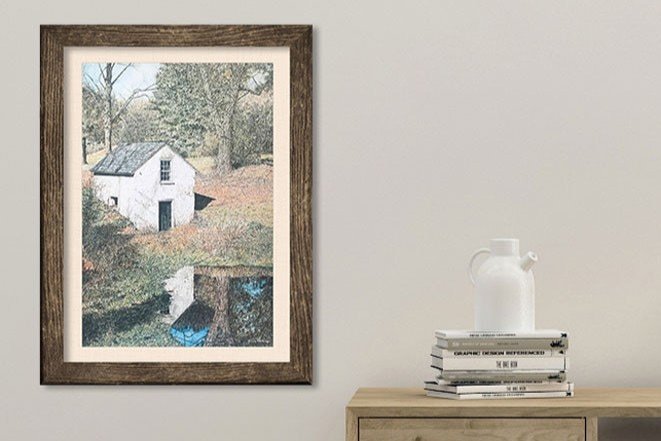
A nurse who worked nights bought a painting for the wall opposite her bed. She had scrolled through hundreds of pieces labeled calming wall art and most of them left her cold, pale abstracts and stock photographs of beaches that looked like a screensaver. The one she chose was a small field at the end of the day, the grass gone gold and a line of trees holding the last of the light. She said she picked it because it looked like somewhere she had actually stood. Three years later it is still the last thing she sees before she sleeps, and she has never once wanted to move it.
That is the test, really. Calming wall art is not a style or a color scheme. It is any piece that gives the eye somewhere gentle to land and keeps giving it, year after year. Some subjects do that more reliably than others. The landscapes painted here are built around exactly that quality, though the reasons run deeper than “put a field on the wall.” Once you know what makes a painting restful, you can spot it in any style and in any room. Where to hang it once you have is covered in the earlier guide to art for a calm home.
Key Takeaways
Subject Comes First: Scenes that ask nothing of you, such as fields, water, quiet woods, and birds, rest the eye in a way busy images cannot.
Light Decides the Mood: Soft, low light reads as calm, while hard midday light reads as active even in a peaceful scene.
Palette Should Whisper: Muted greens, soft blues, warm neutrals, and dusky golds settle a room; high contrast wakes it up.
Space Is Part of the Picture: A painting with open sky or an empty foreground gives the mind room to breathe.
Calm Is Not the Same as Bland: The most restful pieces still have detail and depth, which is why they hold up over years.
If you would like help finding a piece that quiets a particular wall, you are welcome to contact the studio.
Why Some Subjects Rest the Eye and Others Do Not
The nurse’s instinct was right. Calming wall art almost always shows something the viewer could stand inside.
A field, a river bend, a stand of trees, a bird on a fence post. None of these demand anything. There is no face to read, no story to follow, no tension to resolve. The eye wanders in, finds nothing urgent, and slows down. Researchers who study this call it soft fascination, the kind of attention nature holds without effort. It is the reason a window onto a garden does more for a tired mind than a window onto a street.
Painted nature carries that same quality indoors. It also keeps it. A real view changes with the weather and goes dark at five in winter. A painting of a June meadow stays June.
Not every nature scene qualifies, though. A storm over a canyon is nature and it is not calming. A crowded flower market is nature and it is exhausting. The restful ones share a stillness, a moment where nothing is about to happen, and that is worth looking for before anything else.
Light Does More Than the Subject
Two paintings of the same field can feel like different countries, and the difference is nearly always the light.
Low, warm light from early morning or late afternoon reads as peace. It softens edges, lengthens shadows, and turns ordinary grass to gold. Hard overhead light does the opposite. It flattens the scene, sharpens every contrast, and makes even a quiet meadow feel like noon in July with no shade.
This is why light matters so much in the work here. The artist has said that light is both his inspiration and his challenge, and the role of light in painting is where that gets its full explanation. For choosing calming wall art, the short version is enough. Look at the hour of day the painting shows. Dawn and dusk are almost always the restful ones.
Does Calming Wall Art Have to Be Abstract?
No, and for many people the opposite is true.
People recommend abstract art for calm rooms because it is quiet, and some of it is. The trouble is that a pale gray canvas with two soft shapes on it can feel less like calm and more like absence. There is nothing to return to. After a month the eye stops visiting it at all, a strange fate for something you hung in order to look at.
Realism gives the eye a place to go back to. A painting with real detail rewards the second look and the hundredth. A fence rail, the texture of bark, a bird’s feathers caught in the light. That is the difference between a room that feels empty and a room that feels settled. Calm is not the same as bland, and the pieces people keep for decades tend to have both stillness and something worth seeing.
Palette and Space Finish the Job
Color and emptiness do the last part of the work, and both are easy to check.
A calming palette whispers. Greens, soft blues, warm neutrals, dusky golds, the colors of a landscape an hour before sunset. High-contrast combinations, pure black against white, saturated red against green, will always wake a room up. That has its place. It is not this.
Space matters just as much. A painting with open sky above the tree line, or an empty stretch of field in the foreground, leaves the viewer somewhere to rest. A canvas packed edge to edge with incident has no such place, however lovely each part might be. When in doubt, choose the piece with more sky.
Calming Wall Art by Room
Every room asks for something slightly different.
The bedroom wants the quietest piece in the house, because it is the last image of the day and the first of the next. Dusk scenes, still water, and soft florals belong here. Keep the palette close to the bedding and the light in the painting low.
The living room can take a little more. A larger landscape with a sense of distance suits a room where people sit and talk. Warm light in the painting tends to flatter the lamps you switch on in the evening. This is the wall where a canvas giclée earns its place. The giclées here are printed on canvas and gallery wrapped. A scene can hang large and unframed and still feel like a painting rather than a poster.
The home office needs a window it does not have. A quiet field or a path into trees, hung where the eye lands when it lifts from the screen, does real work on a hard afternoon. It costs no floor space. Smaller pieces suit this well, and the matted small works fit a standard frame without any custom framing.
Bathrooms and hallways reward restraint. One small, soft piece rather than several. Florals do well in both.
Trust the Piece You Keep Coming Back To
The nurse did not choose her painting by rule. She chose the one that looked like somewhere she had stood, and the rules explained afterward why it worked.
That is usually how it goes. If a piece slows you down when you look at it on a screen, it will do the same on a wall. It will keep doing it long after the trend that told you to buy an abstract has moved on. Calming wall art is the painting you stop noticing you are looking at and never want to take down.
If you have a wall in mind and are not sure what it needs, contact the studio with a photo of the room. Mary and James are happy to think it through with you, with no obligation at all.
Frequently Asked Questions
What makes wall art calming?
Four things, mostly. A subject that asks nothing of the viewer, such as a field, water, woods, or birds. Soft, low light rather than hard midday light. A muted palette of greens, blues, warm neutrals, and dusky golds. And open space in the composition, usually sky or an empty foreground, so the eye has somewhere to rest.
Is abstract art more calming than realistic art?
Not necessarily. Very sparse abstract work can feel empty rather than calm, and the eye stops returning to it. Realistic nature scenes with genuine detail give the viewer something to come back to while still feeling still, which is why many people find them more restful over time.
What colors are best for calming wall art?
Muted greens, soft blues, warm neutrals, and golds like a landscape near sunset. High-contrast combinations wake a room up rather than settling it. Look for one or two colors the painting shares with the room, rather than matching furniture exactly.
What size should calming wall art be?
Large enough to read from across the room and small enough to leave wall around it. Over a bed or sofa, roughly two thirds the width of the furniture is a good starting point. In a hallway or office, a small matted piece often works better than a large one, since restraint is part of the calm.
How much does calming wall art from the studio cost?
Matted small works are $49. Lithographs run $75 to $125. Canvas giclées range from $195 to $795 depending on size, and original acrylic paintings run from $695 to $2,450. Commissions are quoted individually through the contact page.