
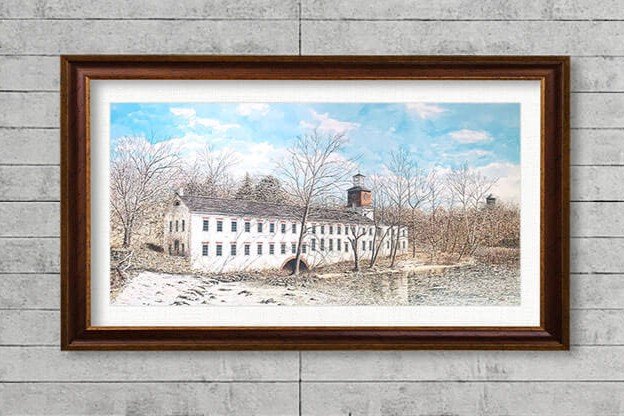
A stone mill on the Brandywine. A stucco cottage behind a wildflower garden. Then a red barn and fieldstone farmhouse in the Bucks County countryside. None of these historic buildings look like much from the road, yet all three carry a date, and one of them carries George Washington.
James Redding has spent a large part of his career painting buildings like these, and he is clear about why. You are not painting an old house or barn. You are painting a place where something actually happened.
Key Takeaways
The Buildings Are Real and Documented: Walker’s Mill dates to around 1815, Hibbs House to 1828, and Headquarters Farm hosted Washington in December 1776.
History Is the Subject, Not the Decoration: He chooses these places because something took place there, and the painting is built to carry that.
Season Is a Tool: Walker’s Mill is painted in winter with the trees bare, so the architecture is visible rather than hidden behind foliage.
Detail Takes the Time It Takes: The windows and the cupola on the mill took hours of careful work, because the architectural detail is where the character lives.
Painting Is a Kind of Preservation: In his words, painting these places is one small way of helping their stories carry on.
If a place matters to you and you would like it painted, please get in touch.
Historic Buildings Like Walker’s Mill Are Hard to Paint
Walker’s Mill sits on the banks of the Brandywine River in Delaware. It went up around 1815 as a cotton spinning mill. The area has known it as a landmark for generations, and it joined the National Register of Historic Places in 1972.
From a painter’s point of view it is also difficult. Look at the front and count the windows. Each one needs the right place, the right size, and the right light. A single window out of line makes the whole facade lean. The detailed cupola at the top took hours of painstaking work on its own.
He painted it anyway, since those details give the building its character. Simplify the windows and you have a generic stone box on a river.
He also chose winter, snow on the ground and the trees along the bank bare. Without foliage you can take in the architecture properly, and details a summer scene would bury come forward.
There is one more thing in that painting worth finding. Look to the right of the mill, into the distance, and Rockford Tower is there. A small cameo, tucked in for anyone who knows Delaware well enough to catch it.
The Farm Where Washington Planned Trenton
Some historic buildings matter for a single week.
Headquarters Farm sits in Bucks County, Pennsylvania, and its ten most important days ran from the fourteenth to the twenty-fourth of December, 1776.
General Washington made the farm his headquarters during that stretch. The Continental Army was in poor shape. Defeats at Long Island and White Plains, a retreat across New Jersey, then the crossing of the Delaware into Bucks County. What he was working on from that farmhouse was the plan to cross back over and strike the Hessian troops at Trenton.
Many of his troops and officers stayed at the nearby Thompson-Neely Farm along the river. For ten days Washington rode back and forth between the two. He met officers to work through the attack, and he visited the sick and wounded at the Thompson-Neely house.
James wanted both halves of that. The history, and the quiet. The red barn and outbuildings, the old fieldstone house, the ordinary countryside around it. Stand in front of it and picturing the place two centuries ago takes no effort, which is the point.
Hibbs House and the Buildings People Feel Attached To
Hibbs House is smaller and has no battle attached to it. It is a quaint stucco house on the grounds of Washington Crossing Park in Bucks County, dating to 1828. Local craftsmen lived there, and an old advertisement called it a wheelwright’s house and shop.
James has painted it more than once, and his favorite version is summer, when the wildflower gardens around it are in full bloom and the color does half the work.
The draw differs from the Washington story. This place simply has something to say. Locals feel a real connection with it, the way people do with a building they have passed their whole lives without going inside.
Washington Crossing Park has kept these buildings and their character intact. Painting them preserves them in his own small way, holding pieces of the past so the stories keep going.
What Makes a Building Worth Painting?
Across the three, a pattern shows up.
He is not after grandeur. A 1828 tenant house is not grand. He is after buildings that carry evidence of use, and places where a specific thing happened on a specific date that can be pointed to.
Then he removes what is in the way. Bare trees in winter for the mill. A season that suits the subject rather than flatters it. Careful attention to whatever makes a building itself rather than any building, which usually means the parts that take longest.
Several of these historic buildings come as lithographs, printed on archival paper and signed. The differences between those and the canvas work are covered in the post on giclée and lithograph prints.
Frequently Asked Questions
What historic buildings has James Redding painted?
Among others, Walker’s Mill on the Brandywine River in Delaware, Headquarters Farm and Hibbs House in Bucks County, Pennsylvania, and The Witness Tree on the grounds of Carnton in Franklin, Tennessee.
How old is Walker’s Mill?
It was built as a cotton spinning mill around 1815 and was added to the National Register of Historic Places in 1972.
What is Headquarters Farm known for?
General Washington used it as his headquarters from 14 to 24 December 1776, while planning the crossing of the Delaware and the attack on Trenton.
Why paint historic buildings in winter?
With the leaves gone, the architecture is visible. Windows, rooflines, and details like the cupola on Walker’s Mill can be seen properly instead of being hidden behind summer foliage.
Can I commission a painting of a building that matters to me?
Yes. Commissioned scenes of specific places are a regular part of the work, including homes and family land. The studio handles commissions personally, and the contact page is where those conversations start.
Small Acts of Keeping
Buildings come down. Owners convert mills, families sell farmhouses, and the tenant house nobody photographed makes way for something with better plumbing.
A painting is not preservation the way a historic register is. It protects nothing. It keeps a version of the place in a room where somebody looks at it, and it holds onto the reason it mattered.
For an artist who has spent thirty years around historic Pennsylvania before settling in Tennessee, that has turned out to be a fair amount of the job. You can browse the work on the prints page.