
Every Friday for eleven years, Margaret bought herself flowers on the way home from work. Grocery store bunches, mostly, whatever looked decent that week. By the following Wednesday they had gone soft and she threw them out. She wanted the Friday feeling without the Wednesday part, which is roughly the point where floral paintings start to make sense to people.
The original florals in the collection are not all doing the same job. Some put a single bloom close enough to count the petal edges. Others step back until the flowers are part of a garden, a fence line, a table by a window. That distance, more than the flower itself, is what decides how a painting behaves once it is on a wall.
It is also the part most people never think about until they have lived with a piece for a month.
Key Takeaways
Distance Changes Everything: A close study of one bloom asks for attention. A garden scene gives a room something to rest against.
The Background Carries the Mood: Softly blended color behind a flower reads differently than a barn, a fence, or an antique table.
Scale Follows the Subject: Large canvases suit the close studies. Smaller pieces suit the scene-based florals.
Light Is the Real Subject: The flower is the occasion. What the light does across it is the painting.
The Same Flower Arrives in Several Forms: Originals, canvas giclées, and matted small works each reproduce different pieces from the collection.
If a particular flower matters to you and it is not in the collection, the studio takes commissions.
Why Are Floral Paintings Harder Than They Look?
Flowers are the subject people assume is easy. They are pretty already. The painter surely just copies what is there.
The trouble is that a flower has almost no structure to hang a painting on. A barn has corners. Bones give a face its structure. A peony is a soft mass of overlapping curves with no straight line anywhere in it, and if a painter renders every petal with equal care the result goes strangely flat. The eye has nowhere to go. Everything is equally interesting, which is the same as nothing being interesting.
The fix is light. Decide where it falls, let the rest drop away, and the flower suddenly has a front and a back and a weight to it.
That decision happens before the first mark goes on the canvas. It is also why two painters can work from the same bouquet and produce pictures that have almost nothing in common. One chooses the light and builds everything around it. The other records the flowers faithfully and wonders later why the result feels like a catalogue photograph.
The Close Look
Amaryllis is the clearest example of the close approach. The blossoms stand tall against a background that has been softly blended into near-nothing, so there is no garden, no context, no story beyond the plant itself. At thirty by forty inches the flowers are considerably larger than life.
A painting like that changes a room. It does not sit politely in the background, and it is not meant to. Hang it where people arrive.
White Floral No. 1 takes the same idea somewhere more contemporary. The detail is intricate, the palette is restrained, and the piece reads as much like a design object as a flower study. People who think they do not like floral paintings often stop at this one.
The Wider Scene
Step back and the flowers start keeping company with other things.
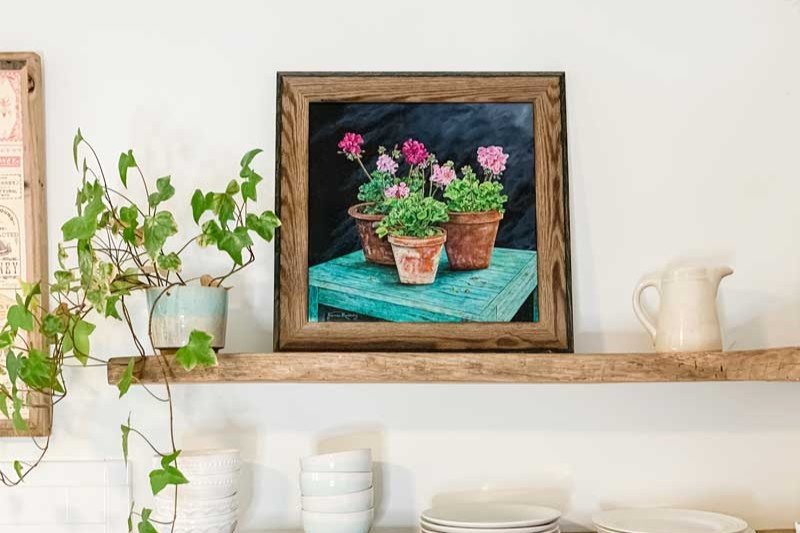
Terra Cotta Pots puts geraniums in clay pots on a colorful antique table, and half the pleasure of it is the table. Coneflowers Along The Fence asks you to look through a cluster of pink coneflowers at a little red barn sitting in a clearing beyond them. The flowers are in the foreground. The subject is the afternoon.
These pieces behave differently on a wall. They ask less, they carry a mood rather than a statement, and they sit comfortably in rooms where people are doing other things. A dining room, a hallway, the wall a staircase turns against.
There is a seasonal quality to them too. Cherry Blossoms sets its flowers in the rolling hills of the countryside, which makes it a spring picture in a way the close studies never are. A close bloom belongs to no particular month. A flowering hillside belongs to April, and some people want exactly that reminder hanging where they eat breakfast in February.
Both approaches are in the collection because both are worth having. Neither is the better one.
What the Background Is Actually Doing
Look at the space behind the flowers in any of these and you can usually tell what the painter wanted from you.
Blended, quiet, almost abstract color means the bloom is the whole event. A recognizable setting means the flower is an entry point and the scene is the reward. Loose, impressionistic suggestion sits between the two, giving enough information to place the flowers somewhere without inviting you to wander off into it.
None of this is accidental, and none of it is visible in a thumbnail. It is one reason a piece can feel different in person than it did on a screen.
How Floral Paintings Reach a Wall
The originals are acrylic on canvas, painted once. When one sells, that is the end of it.
Canvas giclées reproduce later acrylic work. Each is printed on canvas, stretched over wooden bars, gallery wrapped with finished sides, and delivered ready to hang without a frame. The lithographs are a separate and earlier chapter, painted in watercolour rather than acrylic, with a more subdued palette, and no image appears in both collections.
Then there are the small works, matted prints sized for a standard eleven by fourteen frame. Sunflower Garden and Coneflowers both live here. For somebody testing whether they actually want flowers on a particular wall, this is a sensible place to begin.
Frequently Asked Questions
What floral paintings are available right now?
The floral originals include Amaryllis, White Floral No. 1, Terra Cotta Pots, Sunflowers In A Vase, and Sunflower Rhapsody. Availability changes as pieces sell, so the originals page is the current answer. Several florals also exist as canvas giclées or matted small works.
How much do floral paintings cost?
Matted small works are $49 each. Canvas giclées run from $195 to $795 depending on size, and original acrylics on canvas range from $695 to $2,450. Lithographs are $75 to $125.
What size floral painting should I buy?
It depends on the job. A close bloom study like Amaryllis is sized to lead a room and wants a wall of its own. Scene-based florals in the eleven by fourteen to eighteen inch range suit a gallery grouping or a narrower wall.
Can I commission a painting of a specific flower?
Yes. Commissions are handled personally through the studio, and a particular flower, a garden, or a bouquet from an occasion can all be discussed through the contact page.
Do the canvas giclées need framing?
No. They arrive gallery wrapped on one and a half inch wooden bars with finished sides, so they hang as they are. The matted small works are sized for stock frames, so no custom framing is needed there either.
The Thing About Flowers
Margaret bought the geraniums on the antique table. Not the grand one, and not because of the price.
She said the painting reminded her of her grandmother’s back porch, which was not something the painting was trying to do. That is usually how it goes. A flower is a common enough subject that everybody brings their own memory to it, and the good floral paintings leave room for that instead of crowding it out.
If you are weighing a piece and want to know the size, the surface, or how it ships, the studio is glad to answer.