
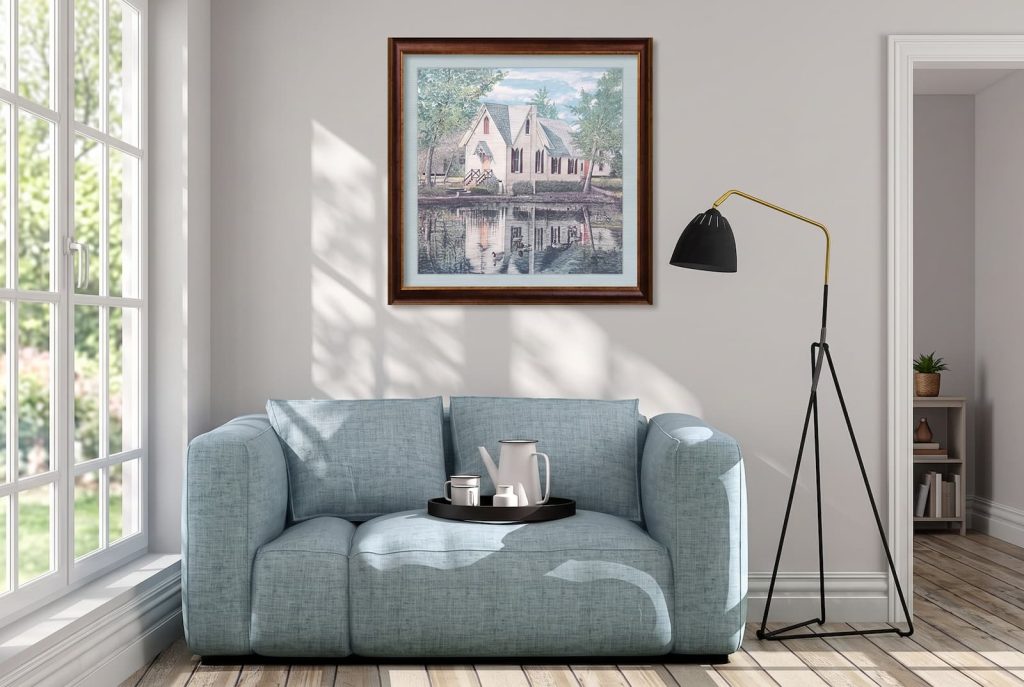
The painting arrives, the wall gets chosen, and then somebody is standing on a chair holding it while somebody else squints from the doorway saying up a bit, no, down. Every household has run this scene. It ends with a hook driven roughly where the arms got tired, which is how most people hang a painting two or three inches too high and then leave it there for a decade.
Height is the easy part, and a tape measure solves it. The decisions that matter more get discussed far less. Where the light falls. What sits underneath. Which rooms quietly damage artwork over ten years without anyone noticing. All of it applies equally to an original acrylic on canvas and to a canvas giclée.
None of this is complicated. It is just rarely written down anywhere before the hook goes in.
Key Takeaways
Center the Piece at Eye Level: The middle of the painting belongs around fifty-seven to sixty inches from the floor, not higher.
Measure From the Furniture, Not the Ceiling: Above a sofa or console, leave roughly six to eight inches of gap.
Direct Sun Is the Real Enemy: Strong daylight across a canvas will alter it over years, so choose a wall that never takes the afternoon sun.
Give It Width to Breathe: A painting wants to occupy about two thirds of the furniture below it.
Canvas Hangs Light: A gallery-wrapped canvas weighs little and needs no frame, so hardware is rarely the problem.
If you are unsure what size fits a particular wall, the studio will talk it through.
The Height Almost Everyone Gets Wrong
Galleries hang work so the center sits about fifty-seven inches off the floor. Some use sixty. Either way, the number refers to the middle of the piece, not the top edge and not the hook. Get that one measurement right and you can hang a painting correctly in any room of the house.
People hang too high because they measure from the ceiling, or because they are holding the thing at chest height while a partner judges it from across the room. Standing changes the sense of what looks right. Sit down in the chair you actually use, and the painting that felt correct a moment ago is suddenly floating.
The fix takes a minute. Find the center of the wall space, measure up fifty-seven inches from the floor, then work out how far the hanging wire or hardware sits below the top of the painting and add that back. Mark it. Hang once.
Hanging Above Furniture
A sofa, a sideboard, a bed, a console table. These change the rule, because now the painting relates to the object rather than to the room. Hang a painting above furniture and the furniture becomes the reference point.
Leave about six to eight inches between the top of the furniture and the bottom of the frame. Less than that and the two read as one crowded block. More than about ten and the painting drifts off on its own, unattached to anything.
Width matters as much as height. A piece that spans roughly two thirds of the furniture beneath it looks settled. A small painting stranded above a long sofa is the other classic error, and no amount of adjusting the height will rescue it. That situation wants either a larger piece or a group.
Light Is What Actually Does Damage
Here is the part worth taking seriously, because it works slowly enough that nobody catches it happening.
Direct sunlight across a painting will change it. Pigments shift, and the effect accumulates over years rather than months, which is exactly why people miss it. A wall that takes strong afternoon sun through an uncovered window is the worst place in the house for artwork, and it is frequently the brightest and most tempting wall in the room.
Indirect daylight is fine. So is ordinary room lighting. If the only possible wall gets real sun, a sheer curtain or a UV film on the glass solves most of it, and the painting can stay.
One more thing on light. A piece that looked luminous in a photograph can fall flat on a dim wall, because what light does to a painting is at least half of what you responded to in the first place. Give it something to work with.
Rooms Where Paintings Struggle
Bathrooms are the obvious one, and the humidity swing is the reason rather than the steam itself. Few places are worse to hang a painting long term.
Directly above a working fireplace is the other. Heat rises, and so does soot, and a mantel is a surprisingly hostile spot for anything on canvas. If the fireplace is decorative or rarely lit, the concern mostly disappears.
Kitchens sit in between. Grease carries further than people expect. A painting across the room from a stove is usually fine, while one directly beside the range will need cleaning in a way nobody wants to be doing.
Unheated spaces with big seasonal temperature swings are worth avoiding too. A three-season porch is hard on canvas.
Groups, Gaps, and Restraint
Multiple pieces on one wall follow a simpler rule than most people assume. Keep the gaps consistent, usually two to three inches, and align something, whether that is the top edges, the bottom edges, or an invisible center line running through the group.
Matted prints make grouping easy because they share a standard frame size. Several of the small works are sized for a stock eleven by fourteen frame for exactly this reason, so a set of three hangs as a unit without custom framing.
The harder discipline is leaving empty wall. A painting needs space around it the way a sentence needs a pause, and a room where every surface is covered gives the eye nowhere to rest. Choosing art that settles a room is partly about what you decide not to hang.
Frequently Asked Questions
How high should I hang a painting?
Center it about fifty-seven to sixty inches from the floor. That places the middle of the piece at average eye level, which is the standard galleries use. Measure to the center of the painting, not the top of the frame.
What size painting fits above a sofa?
Aim for a piece spanning roughly two thirds of the sofa’s width, hung six to eight inches above the back. A single large canvas or a group of smaller works both achieve this.
Do canvas giclées need special hardware?
Rarely. They arrive stretched over one and a half inch wooden bars and gallery wrapped with finished sides, so they are light and hang directly on the wall. A standard picture hook handles most sizes.
Can I hang a painting in a bathroom?
It is not recommended, because repeated humidity swings are hard on artwork of any kind over time. A powder room with good ventilation and no shower is much less of a concern.
How do I hang a painting on plaster or brick?
Plaster takes a picture hook fine if you find a solid spot and angle the nail downward. Brick needs a masonry anchor or a brick clip. For anything heavy, finding a stud remains the safest answer.
Hang It Once, Properly
There is a small pleasure in getting this right that is out of proportion to the effort involved.
Hang a painting at the correct height, on a wall that suits it, with a little room to breathe, and it stops looking like an object attached to a surface. It starts looking like part of the room. Nothing about the piece changed. Everything about how you see it did.
If you would like help judging size before you buy, send the studio a note with the wall measurements.