
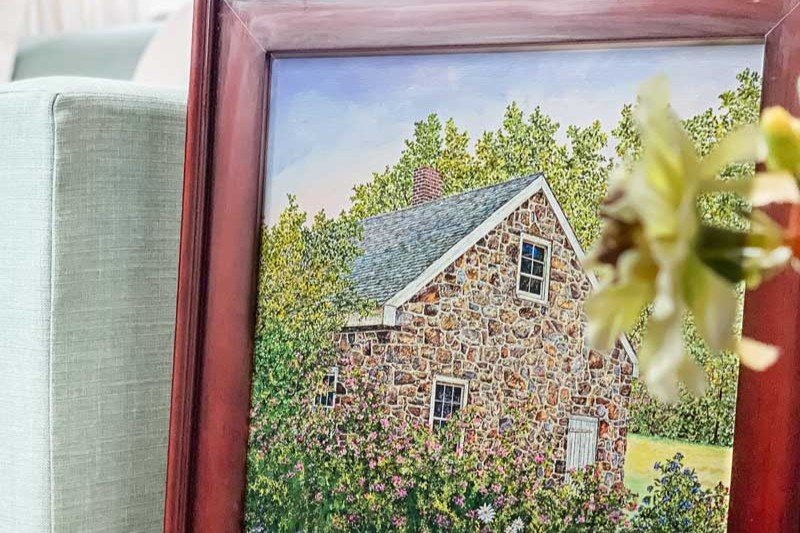
Someone browsing the prints picks a scene, gets as far as choosing a size, and then stops dead at one word. The listing says giclée. It is French, it is unfamiliar, and it is now standing between them and a decision they had already made. Worse, further down the same page sit lithographs at a quarter of the price, and nothing on the screen explains what separates the two.
So, plainly: a giclée is a fine art print made with high resolution inks. It holds the subtle detail, the colour, and the light of the original painting.
The word means sprayed ink, which is honest enough about the process. The printer sprays pigment inks in droplets far too small to pick out by eye, in many more colours and at far finer resolution than any office machine manages. James prints his giclées on canvas. That is the whole idea, and the only decision left to you is the size. You can browse them on the giclée page, or see the wider range on the prints page.
Key Takeaways
Giclée Means Sprayed Ink: The name describes the process, not a quality grade, and the inks reproduce colour, detail, and light closely.
These Giclées Are Printed on Canvas: Giclée printing can be done on paper too, and many artists offer that. James prints his on canvas, stretched and gallery wrapped so it arrives ready to hang.
The Studio Prints Each One to Order: Allow about two weeks for creation before your print ships.
Price Follows Size: Size does nearly all the work in what a giclée costs.
A Giclée Is Not a Lithograph: The lithographs are signed editions on paper, and they reproduce watercolours from earlier in his career. The two collections share no images.
If you have a question, please get in touch.
A Giclée Print Describes a Process, Not a Grade
Part of the confusion is that giclée sounds like a category of art, when all it really tells you is how the printer made the thing. Sprayed, rather than pressed or stamped.
Two things follow. The printer lays down a far wider range of colour than ordinary printing allows, and it works at a fine enough resolution that your eye reads smooth gradients instead of dots.
That matters most where a painting is doing its quiet work. A sky shifting from gold to lavender. The shaded side of a tree trunk, which is never one flat colour no matter how it looks from across the room. Cheap reproduction loses those transitions first, and once they are gone the whole thing goes slightly dead. Light is the real subject in Redding’s work, which the about page explains.
How a Giclée Is Actually Made
The process starts with the finished painting rather than with a file. The original is captured at high resolution, then colour matched against the painting itself, so the printed sky is the sky James mixed rather than an approximation a screen suggested.
From there the canvas is fed through the printer and the inks go down. It comes off flat and it is not finished yet. It is stretched over wooden bars an inch and a half deep, wrapped around the sides and secured at the back, with the sides finished in black so the piece reads as a solid object from an angle.
Giclée is a printing method rather than a material, so it can be done on paper as well, and plenty of artists sell paper giclées. James prints his on canvas because the originals are acrylic on canvas. Reproducing a canvas painting onto canvas keeps the surface behaving the way the painting behaves, carrying the same slight texture and sitting under light the same way.
That is also why a giclée arrives ready to hang. No frame, no glass, no trip to the framer you keep meaning to visit. The depth of the bars gives it presence, and canvas catches light much the way a painting does.
What the Price Reflects
The range is wide, so here is what moves it.
Size does nearly all of the work. A sixteen by twenty sits somewhere near the middle; a thirty by forty sits at the top, because it uses more canvas, takes longer to stretch, and asks considerably more of the printing.
For context, lithographs and matted small works cost less, while original paintings made entirely by hand sit well above them on the originals page.
A giclée print sits deliberately in between. It is for anyone who wants a particular scene at a particular size, on a wall that will hold it for years, without the commitment of an original. Our comparison of original paintings and prints walks through that decision.
The Studio Makes Each One After You Order
Giclées never sit in storage waiting for a buyer. Each one is printed after you order it, which is why the studio asks for about two weeks before shipping.
Worth knowing before you buy, because it changes what you expect. This is not a same week purchase. It is closer to ordering something made for you, and those two weeks are the making. Lithographs and small works ship within one to two business days instead, since the studio prints those ahead.
Choosing a Size for Your Wall
The most common regret with any print is buying one too small. A piece that looked generous on a screen can look stranded above a sofa, and there is no fixing it afterwards.
So try this. Measure the wall, cut a piece of paper to the size you are considering, and tape it up for a day. Live with the rectangle before you commit to the image.
Above furniture, aim for something spanning roughly two thirds the width of the sofa or console beneath it. That proportion nearly always feels settled, and our guide to art for a calm home covers placement further. Redding’s giclées come in a range of shapes, including long horizontals that suit a mantel and larger rectangles for a wall that has to carry a whole room. If you are unsure, the studio will gladly talk it through.
Bringing One Home
Most of the worry about the word disappears once it stops being a mystery. It names a printing method, chosen because it holds on to the parts of a painting that vanish first.
If the more saturated acrylic work is what draws you, the giclées are where to look. If the quieter watercolour scenes caught you instead, the lithographs are their own collection. Either way what you are bringing home is the colour and light of something made by hand first, and that is the part worth having.
You can see the full collection on the prints page, or contact the studio with a question about size, framing, or a scene you have your eye on.
Frequently Asked Questions
Is a giclée print the same as a poster?
No. A poster is mass printed in a limited colour range, usually on thin paper. A giclée sprays pigment inks onto canvas at very fine resolution, and the studio produces each one individually. You can see the difference in the gradients, especially in skies and shadows.
How much does a giclée print cost?
Giclées run from about $195 to $795. Size does nearly all of the work, since a larger piece uses more canvas and asks more of the printing.
Do I need to frame a giclée print?
No. The giclées arrive stretched over wooden bars and gallery wrapped with finished black sides, ready to hang straight out of the box. No frame, no glass, no framer.
How long does a giclée take to arrive?
Allow about two weeks for the studio to make it, plus shipping time. Each one goes into production after you order rather than coming from stock.
How is a giclée different from a lithograph?
Two ways. The printing differs, since a giclée is sprayed digitally onto canvas and made to order, while a lithograph is printed as a signed edition on archival paper and ships from stock within one to two business days. The work differs too, since the lithographs reproduce watercolours from earlier in his career with a more subdued palette, and the giclées reproduce his acrylic paintings. The two collections contain different images.
How should I care for a giclée print?
Treat it as you would a painting. Keep it out of direct sunlight, away from steady heat and damp rooms. Dust a canvas surface gently with a dry cloth rather than a wet one. If you feel unsure about the light in a spot, just ask before hanging it.