
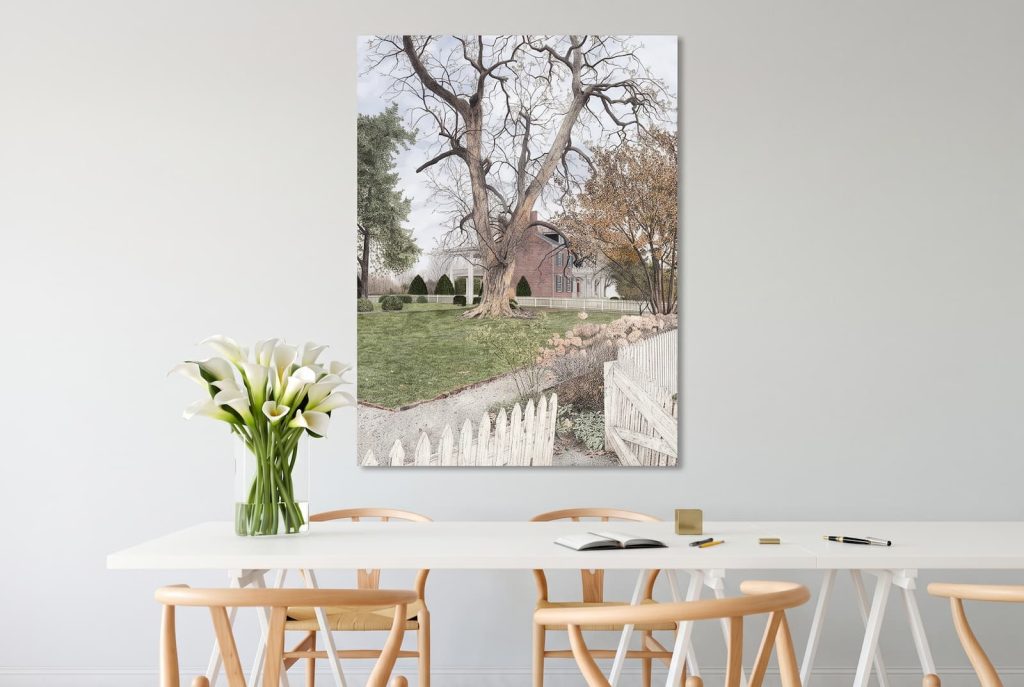
Locals call it The Witness Tree. It stands on the grounds of Carnton in Franklin, Tennessee, an Osage orange of roughly two hundred years, and most people walk past it without stopping. The trunk has gone thick and strange. The branches twist in directions no nursery tree would be allowed to, so it is not pretty the way a maple in October is pretty.
It was standing there in November of 1864, during the Battle of Franklin.
That is the whole reason it has a name, and it is why James Redding painted it.
Key Takeaways
The Tree Is Real and Still Standing: The Witness Tree is an Osage orange of about two hundred years on the grounds of Carnton in Franklin, Tennessee.
It Was There During the Battle: The Battle of Franklin took place in November 1864. The tree was already mature when it happened.
Carnton Became a Field Hospital: The house visible in the background of the painting was used to care for wounded soldiers. Accounts from the time describe men resting against this tree.
November Was a Deliberate Choice: James painted the scene bare, in the same month as the battle, so nothing hides the branches or the base of the trunk.
Character Was the Subject: The massive trunk, the unusual shape, and the gnarled branches are the point. Age is what he was painting.
If a particular scene has your attention, you are welcome to get in touch.
Why Is It Called The Witness Tree?
Franklin sits about twenty miles south of Nashville, and on the last day of November in 1864 it became the site of one of the most costly afternoons of the Civil War. Carnton, the plantation house on the edge of the field, became a field hospital. Stretcher parties brought wounded men in faster than anyone could treat them.
Some accounts from the time describe soldiers leaning against a tree on the grounds, or resting underneath it, waiting.
That tree is still there. More than a hundred and sixty years later, it is still putting out leaves.
Most historical painting works from documents and imagination. This one did not have to. The subject survived.
Seeing the Tree Beneath the Leaves
The obvious way to paint a two-hundred-year-old tree is in summer, full and green and photogenic. James went the other way.
He painted it in November, bare, with the leaves gone. Partly because November is when the battle happened, so the season carries the meaning. Mostly because the leaves were in the way.
Strip a tree of its foliage and what is left is structure. The immense base. The way the trunk has thickened and warped over two centuries of standing in one place. Those gnarled branches, which are the most interesting thing about the tree and the first thing a summer canopy hides.
He wanted the character that comes with age, and the character is in the wood.
Carnton in the Background Is Doing Work
The plantation house sits behind the tree in the painting rather than beside it. That placement is a decision.
Put the house forward and the picture becomes a painting of Carnton, a building portrait, and the tree turns into landscaping. Put it back and the relationship reverses. The tree becomes the subject and the house becomes the reason the tree matters, sitting there quietly reminding you what happened on this ground.
It also keeps the scale honest, because a house in the background makes the trunk read as genuinely enormous.
The Witness Tree Is a Participant, Not a Record
James has painted a lot of historic structures over the years, in Pennsylvania and Delaware as well as Tennessee. He is drawn to places where something happened.
The difference with the Witness Tree is that a building is a record of a moment. A tree is a participant in it. The wood that is putting out leaves this spring is the same wood that was there in 1864. Nobody rebuilt it, restored it, or reconstructed it from a photograph. It simply kept going.
That is a strange thing to stand in front of, and it is what the painting is trying to hand you. Not a history lesson. The specific feeling of looking at something that was present.
The Witness Tree comes as a giclée, printed on canvas and gallery wrapped so it arrives ready to hang. There is more on how those are made in the post on what a giclée print is.
Frequently Asked Questions
Where is the Witness Tree?
It stands on the grounds of Carnton in Franklin, Tennessee, about twenty miles south of Nashville. Carnton is open to visitors, so the tree in the painting can be seen in person.
How old is the Witness Tree?
Roughly two hundred years. It was already a mature Osage orange at the time of the Battle of Franklin in November 1864, which is more than a hundred and sixty years ago.
What happened at Carnton during the Battle of Franklin?
The house served as a field hospital for wounded soldiers. It appears in the background of the painting for that reason. Accounts from the period describe wounded men resting against the tree on the grounds.
Why is the tree painted without leaves?
Two reasons. November is the month of the battle, so the bare season carries the history. It also lets you see the structure of the tree, the trunk and the gnarled branches, which a full canopy would hide.
Can I buy The Witness Tree as a print?
Yes. It is available as a canvas giclée, stretched over wooden bars and gallery wrapped, ready to hang without framing. Giclées are made to order, so allow about two weeks. Prices for giclées run from $195 to $795 depending on size.
Standing Where It Happened
Franklin is full of markers and plaques, and they do necessary work. They tell you what happened and when.
A tree does something different. It does not explain anything. It just stands there, older than the event, still alive, and lets you do the arithmetic yourself.
That is what James was after, and it is why the painting is bare and quiet rather than dramatic. You can see the rest of the collection on the originals page, or reach out with a question about a scene, a size, or a commission of a place that matters to you.
If The Witness Tree speaks to you, you can purchase the painting here.