
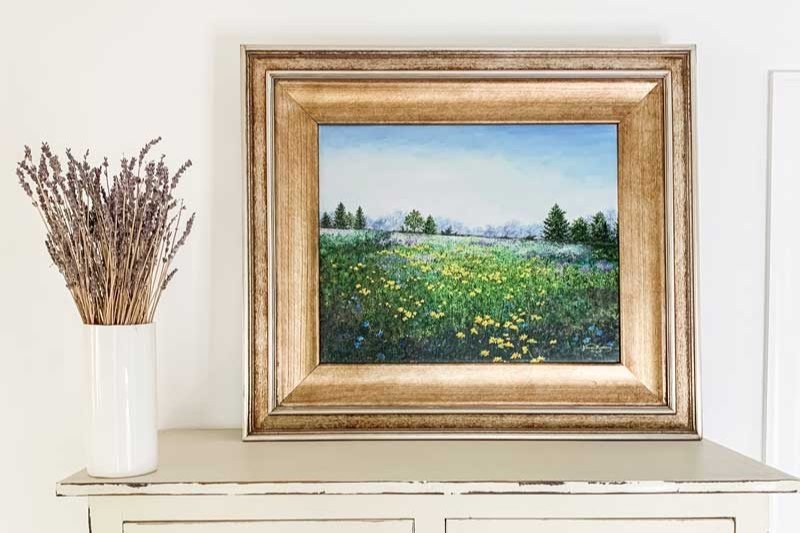
There is a wall in almost every house that seems too small for art.
It might be the narrow stretch beside a doorway, the space between two windows, the end of a hallway, or the few feet of wall above a table that is already doing several jobs. A large painting overwhelms it. Leave it empty and the room feels unfinished.
This is where small original paintings tend to earn their place.
They do not need the commanding wall above a sofa or fireplace. In fact, many work better somewhere quieter, where you pass close enough to notice the brushwork, the light on a field, a bird tucked into a branch, or the detail in an old building.
A small painting does not have to fill a room to change one.
Key Takeaways
Small Paintings Reward Close Viewing: Put them where you naturally pass within a few feet rather than expecting them to carry a large wall from across the room.
Use the Walls Large Art Cannot: Hallways, corners, shelves, small entryways, and spaces between windows are often better suited to a small original.
One Piece Can Be Enough: A small painting does not automatically need to become part of a gallery wall. Giving it some empty space can make it more noticeable.
Match the Scale to the Furniture: Small tables, desks, nightstands, and narrow consoles usually call for artwork with similar visual weight.
Buy the Painting Before Solving the Wall: If a small original is the piece you keep returning to, there is usually more than one good place for it in a home.
You can browse James Redding’s currently available original paintings to see which sizes and subjects are available.
Why Small Original Paintings Work Differently
Large paintings are usually asked to establish a room. Small paintings can do something more personal.
You encounter them rather than taking them in from across the room.
That difference matters with detailed realism. From a few feet away, things appear that would disappear at a greater distance: a change in the sky, the edge of a branch, the texture of an old wall, reflected light on water, or the marks that give a bird its shape.
The experience becomes closer to looking through a window than looking at a piece of decoration.
That is one reason small original paintings should not be judged by how much wall they cover. Their scale is part of how they are meant to be seen.
1. The Narrow Wall Everyone Ignores
Start with the places where a larger painting simply will not fit.
A strip of wall beside a doorway. The space between two windows. The short return wall at the end of a hall. The wall between a cabinet and a corner.
These spots are often left empty because standard decorating advice concentrates on large focal walls. Yet a small original can look unusually deliberate there precisely because the proportions make sense.
The useful rule is simple: let the painting belong to the wall it is on.
A small piece surrounded by a reasonable amount of empty wall usually looks intentional. A small piece stranded in the middle of an enormous wall tends to look lost.
2. Above a Small Piece of Furniture
Artwork often feels right when its scale has some relationship to what sits beneath it.
A narrow console does not necessarily need a wide landscape. A bedside table does not need a painting sized for a mantel. A small desk, reading table, chest, or cabinet can support something much more intimate.
This is one of the easiest ways to place a small original because the furniture gives the painting a visual anchor.
Rather than asking, “Is this painting big enough for the room?” ask, “Does it feel right with what is directly beneath it?”
That is usually the more useful question.
3. In a Hallway Where You See It Up Close
Hallways are excellent places for small original paintings because distance takes care of itself.
You cannot stand twenty feet away from the work even if you try. You approach it, pass beside it, and see it at the distance where detail matters.
That makes a hallway particularly well suited to the quieter subjects in James’s work: landscapes, birds, gardens, old buildings, water, and scenes built around subtle changes in light.
One small painting can work on its own, or several can be placed along a longer hallway if they share enough in mood or scale to feel related.
They do not have to match perfectly. A home collected over time usually looks better when it does not.
4. Beside a Reading Chair
A reading corner is another place where small art makes more sense than something imposing.
The chair, lamp, table, and painting already create a small room within the room. The artwork only has to belong to that arrangement.
This is especially effective with paintings that are quiet enough to live with at close range. A wooded path, still water, a bird on a branch, or a landscape caught at the end of the day does not demand attention every time you sit down.
It simply becomes part of the corner.
James’s work often begins with these quiet moments in the natural world, so smaller pieces can feel particularly at home in places meant for slowing down.
5. In an Entryway
Entryways rarely offer generous walls.
There may be a door, a closet, a light switch, a staircase, and a narrow table all competing for the same few feet. This makes them difficult places for large art and very good places for small originals.
A painting here does not need to announce the entire house. It only has to make the entrance feel considered.
Because people see an entryway every time they come home, this is also a good place for a subject with some personal pull rather than something chosen simply because the colors match.
6. Between Two Windows
The wall between windows is one of the most useful places for vertical or compact artwork.
The architecture has already created a natural frame for the painting. You are not inventing a composition on a blank wall; the room has done half of the work.
Pay attention to width here. The painting should have enough breathing room that it does not appear squeezed between the trim.
If the wall is narrow, resisting the urge to fill every inch usually produces the better result.
7. On a Stairway or Landing
Stairs create the same advantage as hallways: the viewer naturally moves close to the painting.
A small original on a landing can be particularly effective because people slow down there. It becomes something noticed in passing rather than something staged as the main event.
If several paintings climb a stairway together, keep the spacing deliberate. The individual pieces can differ in subject and dimensions as long as the group has a clear rhythm.
But do not assume a staircase requires a gallery wall. One well-placed painting on a landing can do more than six pieces competing up the stairs.
Does a Small Painting Need a Gallery Wall?
No.
Small paintings are constantly shown in groups online, which has created the impression that a single small work cannot carry a wall by itself.
It can.
A gallery wall works when you have several pieces you genuinely want to see together. It is less successful when additional art is bought simply to make the first piece look large enough.
Try hanging the original by itself first. Give it some space and live with it for a week.
You may find that the empty wall around it is doing useful work.
How High Should You Hang a Small Original Painting?
The center of the painting should generally feel comfortable at eye level, but the room matters more than a rigid measurement.
If the painting hangs above a table or cabinet, relate it to the furniture instead of treating it as a separate object floating higher on the wall.
If it sits beside a chair, think about how it looks both while standing and while sitting nearby.
And in a hallway or stairwell, stand where people will actually approach the painting before deciding where the nail goes.
A useful trick is to cut a piece of paper to the dimensions of the painting and tape it to the wall first. It is much easier to move paper three times than a nail.
Small Does Not Mean Less Important
Size and significance are easy to confuse.
A large painting naturally attracts attention because it occupies more of the room. That does not make a small original a lesser piece.
The artist still worked directly on that surface. The brushwork is still there. The decisions about light, composition, color, and detail happened on that one painting, and the finished work remains one of a kind.
If you are still deciding whether an original or reproduction makes more sense for a particular room, the guide to original paintings vs prints covers that question separately.
Once you have decided you want an original, scale becomes a matter of where and how you want to live with it.
Choosing the Painting Before the Location
People often approach art buying in reverse.
They measure an empty wall, decide they need something twenty-four inches wide, and begin looking for an object that satisfies the measurement.
That works for filling walls. It is not always the best way to buy original art.
If a painting keeps bringing you back to its page, start there.
A smaller original is especially forgiving because a house usually has several places where it could work. What begins above a desk may eventually move to a hallway. A painting beside a reading chair may move to a bedroom after the room changes.
The useful question is not always “Where will this fit today?”
Sometimes it is simply “Would I still want to look at this ten years from now?”
Frequently Asked Questions
Are small original paintings good for small rooms?
Yes, but they are not limited to small rooms. They work especially well wherever the viewing distance is short, including hallways, reading corners, entryways, bedrooms, stair landings, and narrow sections of wall.
Can one small painting hang by itself?
Absolutely. A small original does not require a gallery wall. Give the piece enough open space around it and make sure the scale suits the particular wall or furniture nearby.
Where should I hang a small landscape painting?
Look for a place where you naturally come within a few feet of it. Hallways, reading areas, smaller walls, desks, consoles, and stair landings all allow the details in a landscape to be appreciated at close range.
Should small artwork be grouped together?
Only if the pieces genuinely work together. Similar mood, subject, framing, or scale can help create a coherent group, but there is no need to turn every small painting into part of a collection on one wall.
Is a small original painting still one of a kind?
Yes. Size does not change what an original is. James’s original paintings are individually hand-painted works, so the original surface is the one the artist actually worked on.
Can I commission a small original painting?
Commission possibilities depend on the subject and size you have in mind. If you are considering a particular scene, home, landscape, bird, or other personal subject, contact the studio to discuss what would work best.
The Wall Does Not Have to Be Important
Some of the best places for art are not the walls anyone notices when they first enter a room.
They are the wall beside the chair you use every morning. The end of the hallway you walk down before bed. The space above the small table where you leave your keys. The landing where afternoon light arrives for half an hour.
A small original painting can belong to one of those places without trying to dominate it.
And because you meet it at close range, you may end up looking at it more often than the large piece hanging over the sofa.
Browse the available original paintings, or ask the studio if you would like help choosing a piece for a particular space.