
A man called the studio in some distress. He had ordered a canvas giclée as an anniversary present. The date was four days away. Somebody had just told him that framing a painting properly at a custom shop takes three weeks, and he wanted to know how fast anyone could possibly do it.
The answer was that he did not need to do it at all. His piece was going to arrive gallery wrapped on wooden bars with finished sides, ready to go on the wall that afternoon. He had spent two days worrying about a step that was not in the process.
That confusion comes up often enough to explain properly. Each format in the print collection arrives finished in its own way. What a canvas asks for differs genuinely from what a matted print asks for.
Key Takeaways
Canvas Arrives Ready: Gallery-wrapped pieces stretch over wooden bars with finished sides and hang without any frame at all.
Small Works Fit Stock Frames: Each matted print suits a standard eleven by fourteen, so a shop-bought frame works.
A Frame on Canvas Is a Choice: Floater frames exist if you want one, and nothing about the piece requires it.
Glass Wants a Mat: Anything going behind glass needs a spacer so the surface never touches the glazing.
UV Glazing Earns Its Cost: On a wall with real daylight, protective glass does more good than an upgraded moulding.
Questions about how a specific piece arrives are welcome through the studio.
Why Gallery-Wrapped Canvas Needs No Frame
A stretched canvas is already a finished object. That is the part people miss.
The studio prints its giclées on canvas, then stretches each one over bars an inch and a half deep. The sides finish in black, so the edges look intentional from every angle. No raw staple, no bare wood, nothing waiting to be covered up, so you hang it on the wall and you are finished.
The same is true of the original acrylics. James paints on canvas. A piece from the originals collection leaves the studio complete. Some already sit in a slender frame chosen to suit them, and others hang unframed.
Depth helps here. A canvas standing an inch and a half off the wall casts its own small shadow, and that shadow does much of the visual job a frame would otherwise do.
Floater Frames, If You Want One
Some people want a frame regardless. Usually the rest of the room already carries frames, and a bare canvas edge feels unfinished beside them. That is a legitimate reason.
Canvas takes a floater frame. It surrounds the piece with a narrow gap, so the canvas appears to sit inside the frame without touching it. Nothing covers the painted surface. No glass goes in front, and the canvas keeps its depth. A framer can fit one to a stretched piece in an afternoon.
Canvas does not take a traditional rabbeted frame with glass. The stretcher depth does not suit it, and the surface never needed glazing in the first place.
The Small Works and the Standard Frame
The matted prints solve this problem differently and rather neatly.
Each one comes matted to a standard eleven by fourteen inch frame, the size every frame shop and most supermarkets carry. Slide it into a stock frame and hang it, with no measuring, no appointment, no waiting and no custom cost. Several of the small works group together well, so three in matching frames read as a set.
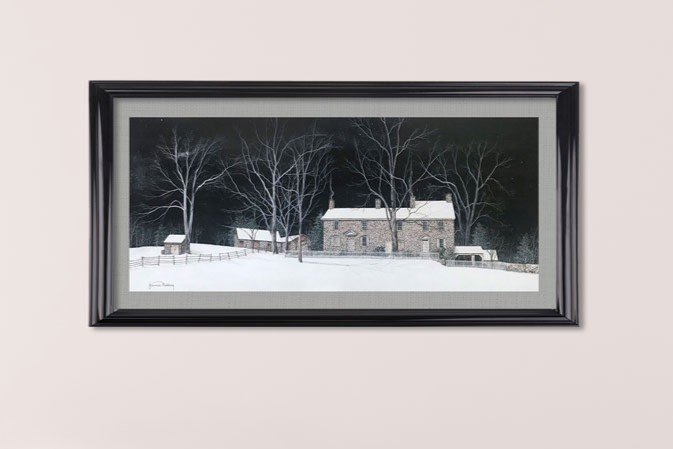
The mat is doing real work here, and not only visually. It holds the print a few millimetres off the glass. That gap matters, because paper resting against glazing can stick over time in a humid room.
Lithographs and Glass
The lithograph collection comes from an earlier chapter of the work. James painted these in watercolour rather than acrylic, and they carry a more subdued palette than the later pieces. No image appears in both collections. These stand as their own body of work rather than alternative versions of anything.
They suit a frame with glazing, in the traditional way, with a mat holding the surface off the glass. That is how this format finishes, in the same way gallery wrapping finishes a canvas. Each arrives complete on its own terms.
Glass, and When Framing a Painting Needs It
For anything going behind glazing, the glass matters more than the moulding does.
Standard glass is clear and cheap, and it offers very little protection from the ultraviolet light coming through a window. Conservation or UV-filtering glass blocks most of it. On any wall that gets real daylight, that is the upgrade worth paying for. Museum glass adds an anti-reflective coating on top, a genuine improvement and a genuine expense.
Non-glare glass deserves a careful thought. It scatters reflections by etching the surface, although that same etching softens fine detail slightly. On work built around precise rendering, that trade is not always worth making.
Acrylic glazing weighs less than glass and does not shatter. That makes it sensible for large pieces, a child’s room, or anywhere a fall seems plausible.
When Custom Framing a Painting Is Worth It
There are real cases for it, even though the formats here mostly arrive finished.
A lithograph destined for a sunny room is the clearest example, because the glazing upgrade genuinely protects the work, and a framer can match a mat to the palette in a way a stock frame never will. Similarly, an oversized piece can need a frame simply for rigidity. In addition, some people are hanging a new piece into an existing wall of framed work, and matching the mouldings is the whole point of the exercise.
Against that, a custom job takes weeks and costs more than most people expect. For a matted small work going onto an ordinary interior wall, the honest answer is that framing a painting at that scale rarely repays the wait.
The rule of thumb: pay for glass and matting, not for elaborate moulding.
Frequently Asked Questions
Do I need to frame a canvas giclée?
No. Each arrives stretched over inch-and-a-half wooden bars, gallery wrapped with finished black sides, and hangs exactly as delivered. Any framer can add a floater frame if you prefer the look. Nothing about the piece requires one.
What size frame do the small works need?
A standard eleven by fourteen inch frame. Each print comes matted to that size on purpose, so a stock frame from any shop fits and custom framing a painting of this kind never becomes necessary.
How much does custom framing cost?
It varies widely by size, moulding, and glass, and a framer is the right person to quote it. For reference on the art itself, matted small works are $49, canvas giclées run $195 to $795, and lithographs are $75 to $125.
Is UV glass worth the extra money?
On a wall that gets daylight, yes. Ultraviolet exposure is the main preventable risk to works on paper, and protective glazing addresses it directly. On a dim interior wall the case is much weaker.
Can I frame an original acrylic painting?
You can, though many are complete as they are. Some originals ship already in a slender frame chosen to suit the piece. If you are considering framing a painting you already own, ask before committing, since the stretcher depth affects what will fit.
The Step That Often Is Not There
The man with the anniversary hung the canvas on the Thursday, two days early. His wife assumed he had planned it that way for months.
Framing a painting is a real craft, and some pieces genuinely need it. The useful thing is knowing which ones. People spend a surprising amount of worry on a step that, for a stretched canvas or a matted print, somebody already handled before the box arrived.
If you are unsure how a particular piece arrives, ask the studio before booking a framer.