
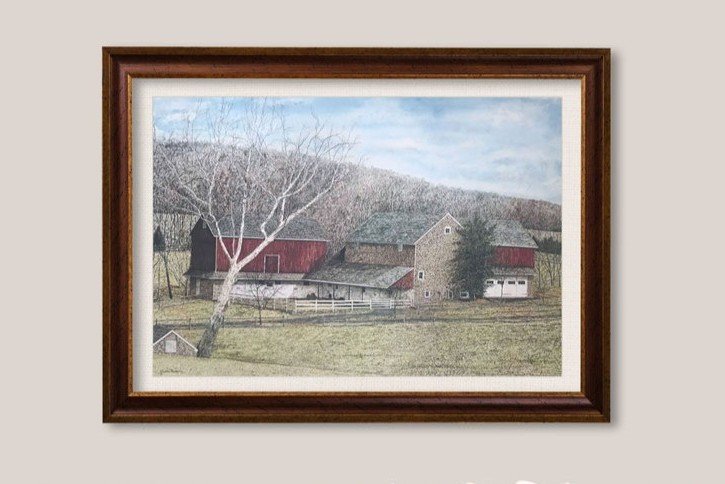
Spend enough time looking through the collection and the geography starts to raise a question.
The studio is in Franklin, Tennessee, yet Pennsylvania runs through much of the work. There are Bucks County farmhouses, canal paths and bridges, Washington Crossing scenes, and buildings tied to the history of the Delaware River. Cross the state line and Walker’s Mill appears along the Brandywine in Delaware.
Then Tennessee enters the collection with places such as Carnton and the landscapes around Franklin.
The explanation is simple. Before settling in Tennessee, James Redding spent roughly thirty years living and painting in historic Pennsylvania. Those years did more than provide subjects. They shaped the way he looks at a place.
Key Takeaways
Pennsylvania Shaped the Early Career: James spent roughly three decades painting there before moving to Franklin, Tennessee.
The Subjects Began Close to Home: Farmhouses, mills, towpaths, historic buildings, country roads, and commissioned places became part of the work because they were part of the landscape around him.
History Matters as Much as Scenery: Many of the places are worth painting not simply because they are beautiful, but because something happened there.
Tennessee Added New Ground: Franklin gave James another landscape filled with historic places, including Carnton and its Witness Tree.
The Geography Changed, the Instinct Did Not: Across Pennsylvania, Delaware, and Tennessee, the recurring subject is a place with a story worth noticing.
If there is a particular place you are looking for, or one you would like painted, you are welcome to contact the studio.
Why Are There So Many Bucks County Paintings?
The move to Pennsylvania was not made for painting. James and his family relocated after his wife accepted a promotion.
What the move created was an opportunity.
James left his career in retail visual merchandising and began painting full time. He did not have to search far for subjects. Bucks County provided more than enough.
The landscape carries its history openly. Stone farmhouses sit beside country roads. The old Delaware Canal still runs past locks and towpaths. Covered bridges cross narrow stretches of water. Washington Crossing and the surrounding countryside hold places connected to the winter of 1776.
It is the kind of region where an ordinary-looking building can turn out to have two centuries behind it.
James painted what was around him: landscapes, historic structures, familiar roads, and commissioned places that meant something to the people who lived there. Galleries began carrying the work, and art shows and festivals followed.
The career grew from paying close attention to a relatively small piece of the country.
What Thirty Years in One Place Teaches a Painter
A visitor notices landmarks. Somebody who lives in a region for decades eventually starts noticing everything around them.
The obvious subjects come first: the covered bridge, the historic farmhouse, the autumn road. Stay long enough, though, and the quieter places begin to matter just as much.
You notice when the trees finally reveal the architecture of an old mill. You learn which stretch of towpath catches the late light. You begin to understand that a plain farmhouse matters because of what happened there rather than because it makes an impressive photograph.
Walker’s Mill is a good example. The winter setting leaves the architecture exposed instead of hiding it behind foliage.
Headquarters Farm works differently. Its importance comes from ten days in December 1776, when George Washington used the property as his headquarters while planning the crossing of the Delaware and the attack on Trenton.
Neither painting is simply about an attractive old building.
That became a habit: find the place, learn what is behind it, then wait for the version of it worth painting.
History Is Part of the Landscape
James’s historic paintings tend to avoid monumentality.
The subjects are often modest: a mill, a farmhouse, a tenant house, a tree. Some would be easy to drive past without knowing what happened there.
That is part of their appeal.
A building does not have to be grand to carry history. A field can have been crossed by an army. A farmhouse can have held a general for ten days. A tree can stand long enough to witness a battle and still be there generations later.
The painting gives the viewer a reason to stop at a place that history could otherwise leave in plain sight.
This interest appears throughout the Pennsylvania and Delaware work, and it continued after the move to Tennessee.
Franklin Gave Him a New Set of Places
Tennessee did not replace Pennsylvania in the work. It added another landscape to it.
Franklin has its own concentration of places where scenery and history overlap. The clearest example is The Witness Tree at Carnton.
The Osage orange was already standing during the Battle of Franklin in November 1864. That fact changes the way the tree is seen. It is no longer simply an old tree on beautiful grounds. It becomes a living connection to what happened there.
The instinct behind painting it is much the same as the instinct behind Headquarters Farm.
Different state. Different war. Different subject.
The same question: what happened here, and what remains?
The Witness Tree is also available as a canvas giclée. If you are unfamiliar with the format, the guide to what a giclée print is explains how the studio’s canvas reproductions are made.
Pennsylvania and Tennessee, Side by Side
The result is a collection that does not belong neatly to one state.
Someone who remembers Bucks County may recognize the Delaware Canal, Washington Crossing, or a familiar stretch of Pennsylvania countryside. Someone in Franklin may be looking for Carnton, the town square, or another place closer to home.
Both belong in the same collection because the common subject is not Pennsylvania or Tennessee.
It is attachment to place.
That may come from history, but it can also be personal. A family farm does not need to appear in a history book to matter. Neither does a childhood home, a road driven for thirty years, or a view somebody still misses after moving away.
That is where commissions naturally fit into the work. Painting a place that matters to one family has been part of the studio for years. If a scene is not already in the collection, it does not necessarily mean the conversation ends there.
You can browse currently available work on the original paintings page or explore the studio’s print collections.
Frequently Asked Questions
Where is James Redding based?
James works from his studio in Franklin, Tennessee. Before moving south, he spent roughly thirty years living and painting in historic Pennsylvania.
Why are there so many paintings of Pennsylvania?
Pennsylvania is where James spent a large part of his career. Bucks County and the surrounding region supplied many of his early subjects, including historic buildings, landscapes, canal scenes, farms, and places associated with Washington Crossing.
Has James Redding painted Delaware scenes too?
Yes. Walker’s Mill on the Brandywine River is one example. The Pennsylvania and Delaware pieces naturally sit together because they came from the same period of James’s career in the Northeast.
Are there paintings of Franklin, Tennessee?
Yes. Franklin and the surrounding area appear in several works, including The Witness Tree at Carnton. Tennessee has become a second body of place-based work alongside the earlier Pennsylvania and Delaware scenes.
Does James still paint historic places?
Yes. Historic buildings and landscapes remain recurring subjects. The interest is less in age for its own sake than in places where something happened and where traces of that story can still be seen.
Can I commission a painting of a meaningful place?
Yes. Homes, farms, family land, historic properties, and other meaningful places can all become commission subjects. If you have a location in mind, contact the studio to start the conversation.
The State Changed. The Habit Stayed.
It would be easy to tell this as a story about moving south: a Pennsylvania painter arrives in Tennessee and finds a new landscape.
That is only part of it.
The more interesting continuity is what James kept looking for.
A farmhouse where an army planned its next move. A mill that survived long after its original work ended. A tree still standing on ground where a battle took place. A quiet road or stretch of countryside that means almost nothing to a stranger and nearly everything to someone who grew up there.
Thirty years in Pennsylvania taught James to notice those places. Franklin simply gave him new ones.
The geography changed. The habit of looking for a place with something behind it did not.
If a particular scene in the collection has caught your eye, or there is a place of your own you would like James to paint, get in touch with the studio.