
A customer once chose a hummingbird painting for her mother in less than two minutes from a phone screen. The reaction when the gift was opened was much bigger than the decision that led to it.
That is one of the interesting things about bird paintings. The subject may be small, but people often bring a great deal of memory to it: a feeder outside a kitchen window, a bird that returned every spring, a garden from childhood, or simply the pleasure of watching something wild stay still for a moment.
Look through the bird originals and another pattern appears. Many of the birds are at rest rather than in flight. They sit among blossoms, settle into gardens, or hold their place beside quiet water.
The bird matters, of course. But so does everything around it.
Key Takeaways
Stillness Changes the Mood: A bird at rest creates a quieter painting than one caught in dramatic motion.
The Setting Carries the Scene: Blossoms, gardens, branches, water, and light often do as much emotional work as the bird itself.
Smaller Canvases Suit the Subject: Bird paintings often work especially well at an intimate scale, where they can be viewed from close range.
Accuracy Serves the Painting: The species remains recognizable, but the goal is a complete scene rather than a specimen study.
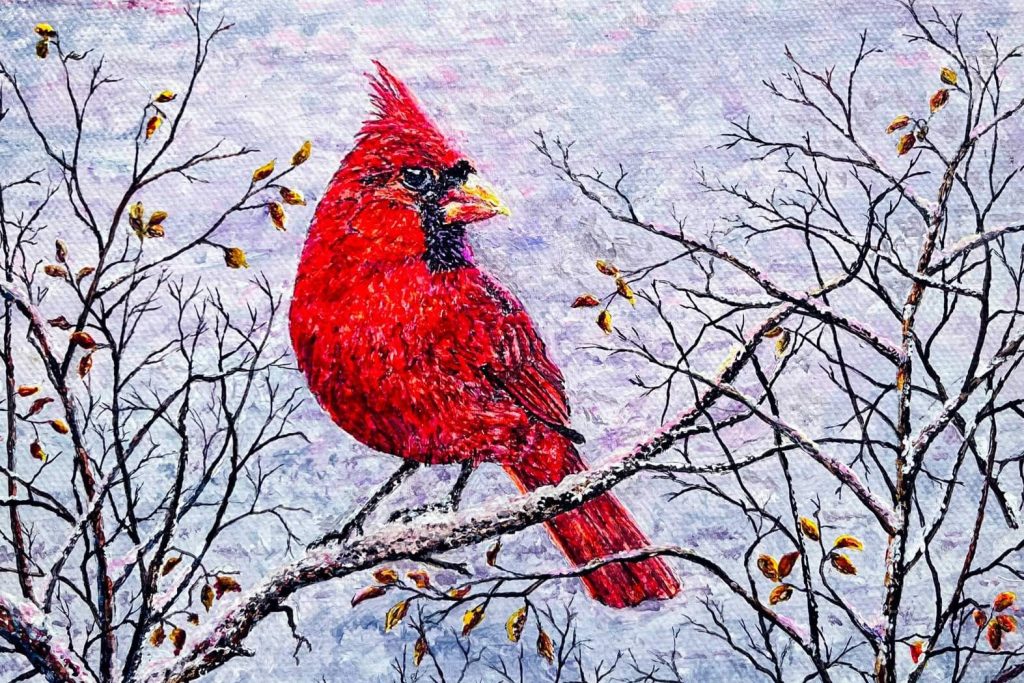
Some Birds Carry Their Own Associations: Cardinals in particular appear often enough in the work to have a story of their own.
If there is a bird with particular meaning to you, the studio also takes commissions.
A Bird Painting Is More Than the Bird
A bird can be rendered accurately and still leave a painting feeling strangely lifeless.
That usually happens when the bird becomes the entire assignment. Every feather is described carefully, the pose is clear, and the background simply fills the remaining space. The result may tell you exactly what the species looks like, but not what it felt like to encounter it.
A painting asks for something more.
The bird still has to be convincing. A bluebird should look like a bluebird and a hummingbird should remain unmistakably itself. But accuracy is only the starting point. The branch, the flowers, the light, the weather, and the space around the bird are what turn identification into atmosphere.
The species tells you what you are looking at. The setting tells you why you want to keep looking.
Why So Many of These Birds Are at Rest
Stillness is one of the quiet decisions that shapes this collection.
Ruby Throated Hummingbird is a good example. Hummingbirds are almost synonymous with movement, so hovering would be the obvious pose. Here, the bird rests on a branch among delicate blooms instead.
That change matters.
Anyone who has watched hummingbirds around a feeder knows how quickly they appear and disappear. Seeing one perch long enough to study it feels almost private. The painting holds that moment longer than life normally allows.
Bluebird In The Garden works in a similar way. The bird is settled into the garden rather than performing for the viewer. Nothing dramatic needs to happen.
A bird in flight can make a painting feel like a captured instant. A bird at rest makes the viewer feel as though they have been allowed to stay.
The Perch Is Half the Painting
One way to understand the bird paintings is to stop looking at the bird for a moment and look at what surrounds it.
Birds of a Feather places its birds on a flowering perch and adds butterflies to the scene. There is more happening than the title subject alone. The flowers, shapes, and movement around the birds give the painting its rhythm.
Other pieces work through blossoms, gardens, or water. Those elements are not decorative backgrounds added after the bird is finished. They are part of the reason the bird belongs there.
Swans at the Inlet makes that especially clear. The birds matter, but so do the inlet, the reflection, the distance between them, and the light across the water. The scene carries the feeling as much as the animals themselves.
These are not simply birds placed against backgrounds. They are places in which a bird has happened to settle.
Why Bird Paintings Often Work at a Smaller Scale
Several bird pieces are relatively small, and the scale suits them.
A broad landscape often benefits from room. Hills, skies, water, and distance can ask for a larger canvas because the subject itself is expansive.
A bird on a branch is different.
It is an intimate subject, something people usually experience from nearby. A smaller painting preserves that feeling. It can sit beside a reading chair, between two windows, along a hallway, above a small table, or anywhere the viewer naturally passes within a few feet of it.
Close viewing also rewards the details: the shift in a feather, the edge of a blossom, the shape of a branch, or a small change in light.
For someone buying an original for the first time, that scale can also make bird paintings an approachable place to begin. They need less wall space than a large landscape while still carrying the character of an original acrylic painting.
Which Birds Appear in the Collection?
Bluebirds appear more than once. Swans also return in different pieces and formats. Hummingbirds, garden birds, and birds settled among flowering branches add variety to the collection.
Then there is the cardinal.
The red bird appears often enough in James’s work to deserve a discussion of its own. Its color makes it visually striking, but people also bring personal associations to cardinals that are different from the way they respond to many other species.
If that is the bird you are drawn to, you can read more about why the cardinal keeps returning in the work.
And if the bird that matters to you is not already represented, commissions offer another route. A species from a childhood yard, a regular visitor to a feeder, or a bird tied to a particular place can all become the starting point for a painting.
Choosing a Bird Painting for Your Home
The easiest place to begin is not with species. Begin with mood.
If you want something quiet, look for a resting bird surrounded by plenty of space. If you want more color, flowers and garden scenes naturally bring more movement into the painting. Water creates a different feeling again, particularly in pieces with swans or reflections.
Scale matters too. A smaller bird painting works best where it can be seen at close range. Rather than asking it to dominate a large wall from across the room, give it a place where someone can stop near it.
Then pay attention to the setting.
The bird may be what catches your eye first, but the branch, blossoms, garden, or water are often what determine whether the painting feels right in the room.
Frequently Asked Questions
What bird paintings are available?
The collection includes bird originals as well as bird subjects in other formats. Current pieces can be viewed through the bird originals collection and individual product pages.
Why are so many birds shown at rest?
A resting bird creates a quieter kind of painting. It also gives the surrounding branch, flowers, garden, or water more room to become part of the subject rather than simply functioning as a background.
What size bird painting works best?
There is no single correct size, but smaller works suit bird subjects particularly well because they reward close viewing. They work naturally in hallways, reading areas, stairways, small walls, and other spaces where the viewer can stand nearby.
Can I commission a painting of a specific bird?
Yes. If there is a particular bird, species, place, or memory you would like reflected in a painting, you can contact the studio about a commission. Reference photographs are often a useful place to begin the conversation.
Are bird paintings a good gift?
They can be, especially when the recipient already has a connection to the species. A bird they regularly see in the garden, associate with a place, or simply love watching can make the painting feel much more personal than a decorative choice alone.
Why These Paintings Feel Personal
Nobody needs a painting to know what a bird looks like. Photography can answer that question instantly.
Painting offers something different.
It allows a fleeting encounter to stay still. A bird that would normally move after a few seconds remains on the branch. The light does not change. The blossoms stay open. The water holds its reflection.
That may be why bird paintings can carry more meaning than their size suggests. People rarely see only the bird. They see mornings at the kitchen window, gardens they remember, feeders they used to fill, or simply the pleasure of noticing something small enough to miss.
The bird is the beginning of the picture. What the viewer brings to it is what makes the painting personal.
If there is a bird you would like painted, or you have a question about an existing piece, the studio is glad to hear from you.